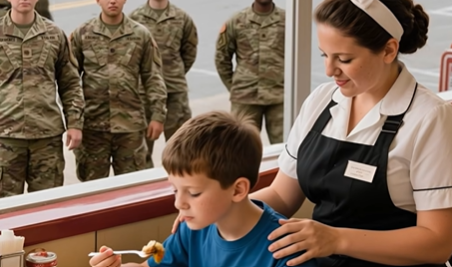
Every morning I fed a lonely boy—secretly, so the staff wouldn’t find out. But one day he didn’t show up: instead of the boy, black cars pulled up at the café, and the letter the soldiers handed me knocked the ground out from under my feet.
Every morning I set out the cups, wiped the tables, and pretended everything was fine. The world around me seemed to be on repeat—the same faces, the smell of coffee, the chime of the bell above the door.
One day I saw the boy. Small, about ten years old, with a backpack that seemed heavier than himself. He always arrived promptly at 7:15 a.m., sat in the furthest corner, and ordered only a glass of water.
On the fifteenth day, I put a plate of pancakes in front of him.
“We accidentally made a few too many,” I said, as if it were just a mistake.
He looked at me for a long time, then said softly:
“Thank you.”

From then on, I brought him breakfast every day. He never told me who he was or why he was alone, without his parents. The boy simply ate and always thanked me.
But one day he didn’t come. I kept staring at the door until I heard the sound of engines outside. Four black SUVs pulled up at the entrance. People in uniform entered and silently held out a letter to me.
??As I read the first words, the plate fell from my hands. A deathly silence fell in the café.
The continuation of the first comment… ? I still remember that day. 9:17 a.m. The air outside seemed to thicken—four black SUVs pulled up at the entrance. People in uniform entered the room, step by step, as if they were carrying not just papers but someone’s fate.
One of them came up to me, took off his cap, and said he was looking for the woman who fed the boy in the morning. My mouth went dry. “That’s me,” I replied.
He pulled out a folded letter. His voice trembled barely.
The boy’s name was Adam. His father was a soldier. He had died in the line of duty.
Before his death, he had written: “Thank the woman from the café who nursed my son. She gave him what the world had taken from him—the feeling that people still remember him.”
As I finished reading the letter, my hands began to tremble treacherously. Everything around me stood still—even the spoons stopped clinking. The soldiers paid tribute. And I simply stood there, unable to utter a word.
It took me a long time to recover from that day. I read the letter again and again, as if afraid the letters would disappear if I let go. Sometimes it seemed as if he would still come—with the same backpack, with the same shy smile.
A few weeks later, I received another letter. From the same officer. Inside—a short note and a photo: the boy, the same one, sits on the grass next to a man in uniform.
It turned out he had been adopted by a friend of his father’s—a soldier whose life his father had once saved.
“Now he has a home. And he often thinks back to the woman who fed him in the morning,” it concluded.